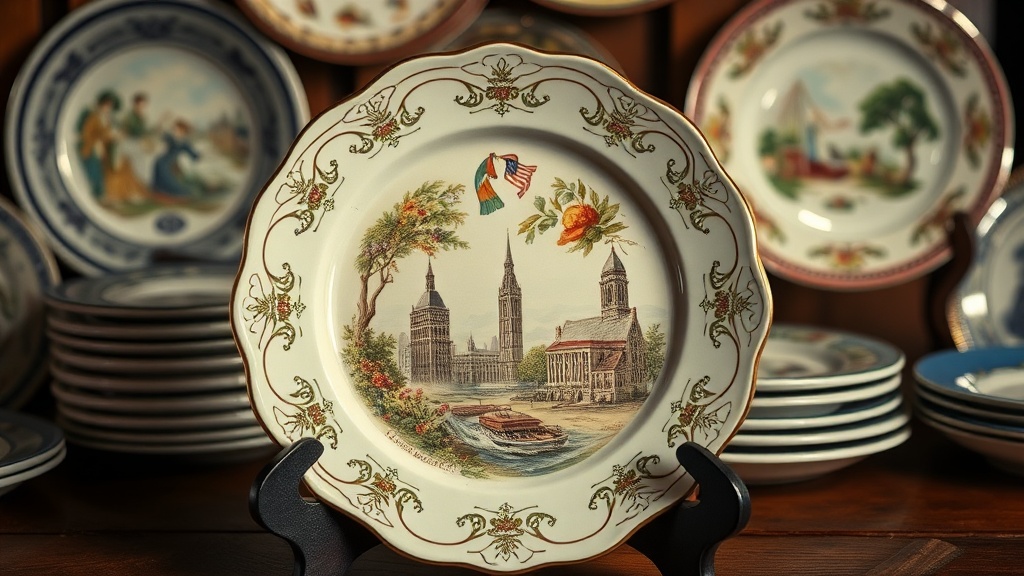
Vintage Souvenir Plates: Complete Collector's Buying Guide

What Should Beginners Know About Collecting Vintage Souvenir Plates?
Vintage souvenir plates represent one of the most accessible entry points into the collectibles market. These decorative items—often commemorating places, events, or historical moments—offer rich variety without demanding expert-level investment. Whether hunting at flea markets or browsing eBay listings, knowing what separates a $5 curiosity from a $500 treasure makes all the difference.
The market spans centuries. Early European examples date to the 1800s, while American souvenir plate production exploded during the 1893 Chicago World's Fair. Modern collectors gravitate toward different eras based on budget, display space, and personal connection to the imagery. Some chase state plates from the 1970s (you know—the ones with gold rims and blue borders). Others pursue hand-painted porcelain from German manufacturers like Meissen or Rosenthal.
Condition matters enormously. A plate with hairline cracks, chips, or significant fading typically loses 60-80% of its value. That said, rarity can override condition issues. The 1904 St. Louis World's Fair commemorative plate in rough shape still commands interest simply because production numbers were limited.
How Do You Identify Authentic Vintage Plates?
Authenticity verification starts with manufacturer marks. Flip the plate over. Most legitimate vintage pieces carry backstamps indicating the maker, country of origin, and sometimes the production year. Look for names like Wedgwood, Spode, Johnson Brothers, or Knowles—all major producers of souvenir ware.
The catch? Reproductions exist. Modern manufacturers sometimes reissue classic designs, and tourist shops still sell "vintage-style" plates fresh from overseas factories. Here's how to spot the difference:
- Weight and feel: Authentic vintage plates typically feel heavier than modern reproductions. The glaze has depth—you'll notice subtle irregularities rather than perfect uniformity.
- Backstamp clarity: Older stamps often show slight fading or impression variations. Laser-sharp, perfectly centered marks on "antique" plates raise suspicion.
- Crazing patterns: Fine surface cracking (crazing) develops naturally over decades. Reproductions might fake this, but the patterns look artificial—too uniform or painted on rather than organic.
- Color aging: Genuine vintage plates show gentle yellowing on unglazed portions (the foot ring). Bright white edges on a supposedly 100-year-old piece? Red flag.
Regional variation exists too. English souvenir plates from the Victorian era often feature transfer-printed scenic views with hand-colored accents. Japanese export plates from the 1920s-1940s tend toward delicate lithophane elements (those translucent images visible when held to light). German makers favored high-relief borders and detailed historical scenes.
Common Manufacturer Marks to Recognize
| Manufacturer | Era of Production | Typical Plate Characteristics | Value Range (USD) |
|---|---|---|---|
| Wedgwood | 1890s-present | Jasperware, classical scenes, matte finish | $25-$500+ |
| Johnson Brothers | 1900-1980s | Transferware, historical American themes | $15-$150 |
| Knowles China | 1900-1960s | State plates, gold trim, bright colors | $8-$75 |
| Wood & Sons | 1865-2005 | Scenic English views, blue transfer patterns | $20-$200 |
| Vernon Kilns | 1930s-1950s | California scenes, art deco influences | $30-$300 |
Where Are the Best Places to Buy Vintage Souvenir Plates?
Reliable sources split between physical venues and online marketplaces—each with distinct advantages. Estate sales remain the gold standard for serious collectors. Complete collections often surface when long-time enthusiasts pass away, creating opportunities to acquire matched sets at fair prices. Arrive early on the first day for best selection, or negotiate aggressively on the final day when sellers want items gone.
Antique malls and dedicated collectibles shops offer curated inventory with professional authentication (usually). The markup runs 30-50% above estate sale prices, but you can examine pieces in person. Ask questions about provenance. Reputable dealers document where plates originated.
Online, eBay dominates the secondary market. Filter by "sold" listings to gauge actual market values—not asking prices. Etsy works better for decorative display pieces rather than investment-grade collectibles. Facebook Marketplace and Craigslist occasionally yield local deals, though selection varies wildly by region.
Auction houses handle serious rarities. Heritage Auctions and Christie's occasionally feature significant ceramic collections. Proxibid enables online participation in regional auction houses without travel. Worth noting: buyer's premiums (typically 15-25%) factor into your total cost.
Here's the thing about thrift stores—they're unpredictable treasure troves. Goodwill, Salvation Army, and local charity shops price plates based on size rather than value. A $2.99 plate might be worthless kitsch. Or it might be a scarce 1915 Panama-Pacific International Exposition commemorative worth $400. Check regularly. Learn to scan shelves quickly for quality markers (weight, backstamp presence, detailed artwork).
Red Flags in Buying Environments
- Sellers who won't show the backstamp or provide condition details
- "Rare" claims without comparable sales data
- Plates described as "vintage" but featuring modern landmarks (built after 2000)
- Identical "antique" plates available in bulk quantities
- Excessive restoration—overpainting kills collector value
What Factors Determine the Value of a Souvenir Plate?
Several elements interact to establish market value. Age alone doesn't guarantee worth—a common 1890s plate might sell for $15 while a scarce 1970s piece fetches $200. Rarity trumps age nearly every time.
Subject matter drives demand significantly. Plates depicting World's Fairs—particularly Chicago 1893, St. Louis 1904, San Francisco 1915, and New York 1939—maintain strong collector interest. Presidential inaugurations, state centennials, and military commemoratives attract thematic collectors willing to pay premiums. Banal "welcome to Springfield" tourist plates? Not so much.
Artist attribution matters when identifiable. Limited editions signed by artists like Frances Ward or Sam Hyde Harris (known for California-themed plates) command respect. Numbered limited editions from manufacturers like Bradford Exchange created artificial scarcity—though these often disappoint at resale since production numbers remained high.
Condition grading follows established standards:
- Mint: No defects, original packaging preferred
- Near Mint: Minor shelf wear visible only on close inspection
- Excellent: Light crazing acceptable, no chips or cracks
- Very Good: Minor fading, small rim chips under 1/4 inch
- Good: Visible wear, significant crazing, possible repairs
- Fair/Poor: Major damage, suitable only for study or craft projects
Size creates practical constraints too. Dinner plate sizes (10-11 inches) display best and command higher prices than bread-and-butter sizes (6-7 inches). Oversized chargers (12+ inches) appeal to serious collectors but require dedicated display space.
How Should Collectors Display and Care for Their Plates?
Proper display protects investment while showcasing the collection's visual impact. Plate hangers—those spring-wire contraptions—work for lightweight pieces but stress larger, heavier plates over time. Museum putty or plate rails distribute weight better for long-term wall mounting.
Direct sunlight destroys color. Reds and greens fade fastest. Position displays away from windows or use UV-filtering glass. Temperature fluctuations cause crazing expansion—avoid placement above radiators, fireplaces, or exterior walls with poor insulation.
Cleaning requires restraint. Dust with soft microfiber cloths. Never immerse valuable plates in water—moisture seeps into crazing lines and promotes staining. For stubborn grime, slightly dampen the cloth with distilled water only. Harsh chemicals strip glaze and damage gold trim.
Storage for extras or rotation pieces demands horizontal stacking with felt or foam separators. Never stack bare porcelain against porcelain—contact points chip. Acid-free tissue paper prevents chemical reactions that cause discoloration.
Insurance considerations apply to significant collections. Standard homeowner policies often cap china/ceramic coverage at disappointing levels. Document your collection with photographs, purchase receipts, and current value estimates. Specialty collectibles insurance through companies like Collectibles Insurance Services offers better protection for serious accumulations.
The souvenir plate community remains surprisingly active. Collector clubs, Facebook groups, and annual shows provide education, authentication help, and trading opportunities. The National Joy of Collecting maintains resources for plate enthusiasts specifically. Connecting with other collectors reveals market trends before they hit price guides.
Start small. Pick a theme that genuinely interests you—your home state, World's Fairs, specific manufacturers—and build systematically. The hunt matters as much as the acquisition. That $8 plate discovered at a rural estate sale, backstamp verifying its 1920s origin, creates a satisfaction no retail purchase replicates.