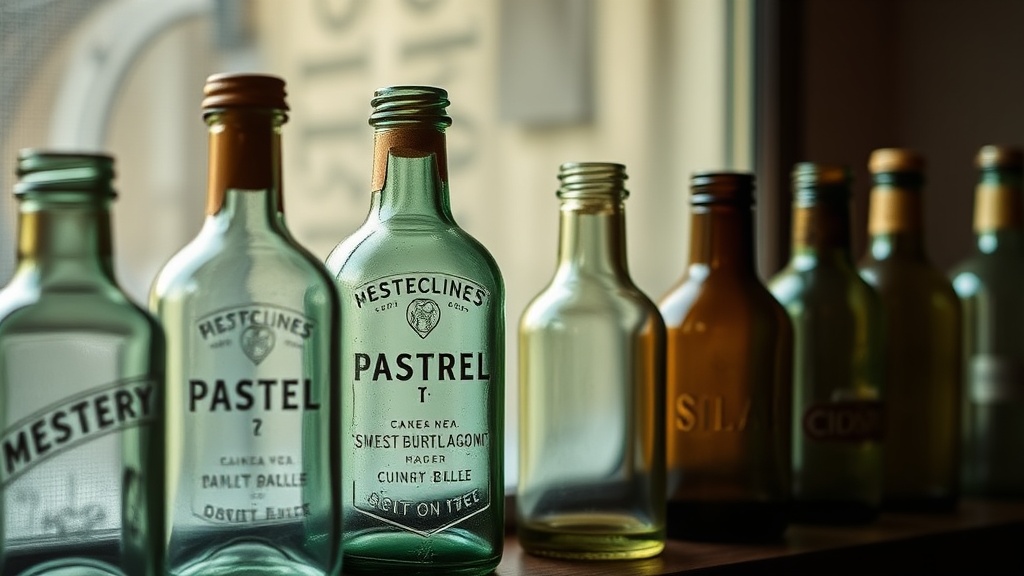
How to Research the Markings on Your Vintage Bottle Collection

What Do the Numbers and Letters on Old Bottle Bases Actually Mean?
You've just brought home a dusty amber bottle from a yard sale—maybe it's a medicine bottle, maybe a soda bottle from some defunct local brand—and you flip it over to find a jumble of raised numbers, a faint diamond shape, or perhaps just a single mysterious letter stamped into the glass. Now what? Those marks aren't random factory accidents. They're intentional identifiers that can tell you where the bottle was made, when it was produced, and sometimes even which specific machine or mold created it. Learning to read these markings transforms a shelf of "old bottles" into a documented collection with real historical weight.
The base of a bottle is where glassmakers left their signatures—sometimes literally. Before modern labeling, manufacturers embossed their identities directly into the glass. Some marks are obvious company names like "Coca-Cola" or "Ball." Others are cryptic: a series of dots, a number paired with a letter, or a symbol that looks like it belongs on a pirate map. These codes served practical purposes in the factory. They helped quality control track defective molds, allowed workers to identify production runs, and (happily for us a century later) created a paper trail cast in glass.
How Can You Identify Who Made an Old Bottle?
Start with the most prominent marking you can see. Is it a name? A logo? Just numbers? Photograph it in good natural light—direct sunlight often creates shadows that obscure raised embossing. Once you have a clear visual record, you have two parallel paths to follow: the specific mark itself, and the bottle's form and manufacturing characteristics.
For the mark, head to the Society for Historical Archaeology's bottle dating page—a free, comprehensive resource maintained by professional archaeologists. Their searchable databases and illustrated guides cover thousands of American and Canadian glass manufacturers. If you see a mark like "ACCo" inside a triangle, that's the American Carbonator Company. A "G" inside a diamond? Probably the Glenshaw Glass Company of Pennsylvania. These details seem small until you realize they connect your bottle to specific factories, towns, and industrial histories.
Don't ignore the numbers either. A "7" or "15" might indicate a mold number—useful for factory records but not directly datable. However, paired digits like "42" or "56" often indicate the year of manufacture, especially on milk bottles and soda bottles from the mid-20th century. Context matters: a "42" on a 1940s-style milk bottle almost certainly means 1942. That same number on a modern liquor bottle probably doesn't.
What Manufacturing Clues Help Date a Bottle Accurately?
The mark itself is only half the story. How the bottle was made tells you just as much. Turn your bottle over and examine the base closely. Do you see a rough, circular scar in the center—a pontil mark? That indicates hand-blown manufacture, likely pre-1900. Is the base perfectly smooth with a distinct seam running up the side? That's machine-made, probably post-1905. The transition era between hand and machine production (roughly 1895–1915) creates some ambiguity, but combining manufacturing clues with base markings usually narrows the window considerably.
Color matters too. That amber tone in your bottle isn't just aesthetic—it was the default for beer and medicine bottles because it blocked ultraviolet light. But the shade itself evolves: 19th-century amber tends toward olive or yellow-brown, while mid-20th-century amber is often darker, more chocolate. Aqua glass (that pale blue-green) dominated food and beverage bottles before the 1920s. Clear glass became standard later. These aren't hard rules—exceptions abound—but they're reliable starting points for your research.
Pay attention to the lip and finish as well. Applied lips (where the top looks added separately from the body) suggest older manufacture. Machine-made bottles have uniform, tooled finishes. The Glass Bottle Marks website offers detailed photo comparisons of these features, helping you match your specimen to illustrated examples.
Where Can You Connect with Other Collectors and Experts?
Online databases get you started, but the real knowledge lives in communities. Facebook groups dedicated to antique bottles, the Federation of Historical Bottle Collectors, and regional clubs all offer something invaluable: eyes on experience. A collector who's handled ten thousand bottles can identify your mystery mark in seconds—or tell you that nobody's figured it out yet, which is its own kind of valuable information.
When posting photos for identification, context helps enormously. Include the bottle's height, base diameter, any embossing on the body (not just the base), and where you found it. "Found in central Ohio cellar" narrows possibilities dramatically. Also mention what the bottle held, if you know—medicine bottles follow different conventions than whiskey flasks or soda bottles.
Local historical societies often maintain records of regional glassworks. A bottle with "Pittsburgh" in the mark clearly points to Pennsylvania's glassmaking history, but even unmarked bottles often cluster geographically. Bottles didn't travel far before railroads and highways made shipping cheap. If you dug it up in rural Vermont, odds are strong it was made in New England—possibly even in-state.
How Do You Document Your Findings for Future Reference?
Research isn't a one-time event—it's an ongoing conversation between you and your collection. Start a simple catalog: photograph each bottle's base, body, and profile. Note the markings, your best guess at date and manufacturer, and your sources. Did the SHA database confirm it? A collector's opinion? Your own comparison with dated examples? Record this. Future you will thank present you when you're trying to remember why you thought that amber flask was from 1912.
Consider creating condition notes, too. Chips, cracks, and stain (that cloudy, iridescent film that develops in buried bottles) affect value and historical context. Some collectors love "dug" bottles with their rainbow patinas; others want mint condition pieces that sat undisturbed on shelves. Neither is wrong, but documenting condition helps you track how your collection evolves—and protects you if you ever sell or insure it.
Finally, revisit your notes periodically. New research emerges constantly. A mark that was unidentified ten years ago might now have a documented source. The bottle collecting community shares information generously, and websites update regularly with newly discovered manufacturer histories. Your "mystery bottle" today might be a confirmed rarity tomorrow—or vice versa, which is part of the fun.
Every bottle base tells a story if you learn to read it. The numbers aren't random. The scars aren't accidents. They're the fingerprints of glassblowers, factory workers, and industrial processes that vanished decades ago. Your job as a collector isn't just to own these objects—it's to listen to what they're saying, trace their origins, and preserve that knowledge for whoever owns them next. That's what transforms accumulation into collecting, and collecting into something that lasts.