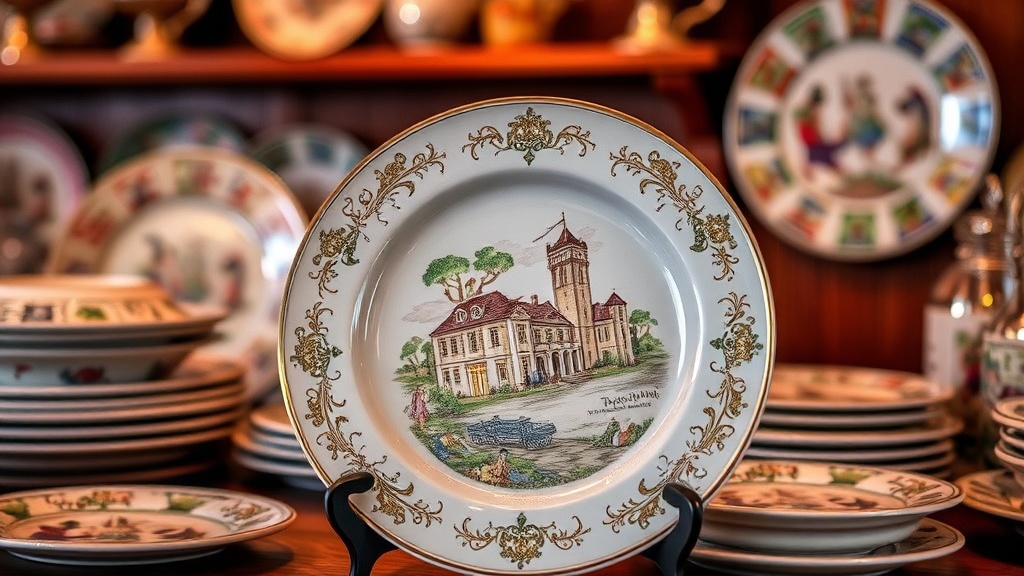
Deciphering Provenance: Your Guide to Souvenir Plate Identification

Have you ever stared at a beautifully decorated souvenir plate and found yourself wondering about its true past?
For many collectors, the allure isn't just in the artwork, but in the untold stories these pieces carry—where they came from, who made them, and what moment in history they represent. Sorting genuine antique treasures from more recent decorative items, or simply understanding a plate's origins, can feel like piecing together a fascinating historical puzzle. This post will walk you through the key indicators collectors use to identify a plate’s provenance, assess its age, and ultimately understand what makes certain pieces more desirable than others. We'll explore everything from the subtle clues embedded in materials and manufacturing techniques to the overt messages found in backstamps and artist signatures, helping you build a sharper, more informed eye for these captivating collectibles.
How can you tell if a souvenir plate is truly old?
Distinguishing between an authentic antique—a piece over 100 years old—and a charming vintage reproduction often comes down to a few telling characteristics. You don't need to be a seasoned appraiser; just focus on concrete evidence in the plate’s construction and finish.
- Material Matters: Early souvenir plates, especially those from the late 19th and early 20th centuries, were typically crafted from fine porcelain or delicate bone china. These materials are renowned for their translucence (hold it up to the light; can you see faint light through it?), their smooth, almost glassy feel, and their characteristic ring when gently tapped. Earthenware and stoneware also made appearances, particularly for more rustic, heavier, or everyday commemorative pieces. Modern plates, by contrast, might use heavier, less refined ceramics or even — in more recent cases — synthetic materials. Run your finger along the rim; do you feel any slight irregularities or subtle variations in thickness? Older, handmade, or semi-handmade plates often show minor imperfections that hint at human touch, a stark contrast to the machine-perfect uniformity of contemporary manufacturing.
- Manufacturing Whispers: Examine the decoration closely—its application tells a big story. Hand-painted designs, with their subtle variations in brushstrokes, slight unevenness in color, and varying pigment depth, are a hallmark of older craftsmanship. You might discern faint outlines of the original drawing or even minor registration errors where colors don't perfectly align—these are often charming, rather than detracting, signs of genuine hand-decoration. As industrial processes evolved, transferware techniques became popular. Here, an image was printed onto tissue paper or film, then transferred to the glazed ceramic. While still highly collectible (and often beautiful), the precision of a transfer differs from freehand artistry. Mass-produced plates of the mid-20th century onwards frequently feature decals, which can sometimes reveal a faint, almost imperceptible texture or a slightly "plastic" sheen when viewed at an angle, particularly under reflected light.
- Rim and Base Clues: The shape and finish of a plate's rim and its base can be surprisingly informative. Older plates often feature a more uneven, hand-finished edge, sometimes with a slightly thicker or more rounded profile than you’d expect from today’s precisely molded items. The foot rim—that raised ring on the underside that helps the plate sit steadily—also offers clues. Early examples might be unglazed or show tiny, rough spots where kiln stilts (small ceramic supports) were used during firing, leaving tell-tale marks. Later pieces, especially after the mid-20th century, tend to have smoother, uniformly glazed bases. Look for wear patterns: a truly old plate, one that's seen a lot of life and handling, will likely show some subtle scratching, rubbing, or slight discoloration on the foot rim from years of being moved, stacked, or displayed. These signs of gentle use are often reassuring, not damaging.
What do the markings on the back of a plate mean?
The back of a souvenir plate is almost always a treasure trove of information, revealing its lineage through various stamps, symbols, and sometimes even handwritten notes. These "backstamps," as collectors call them, are absolutely critical for accurate identification and dating. Ignoring them means missing a huge part of the story.
- Decoding Backstamp Types: Manufacturers have used a dizzying array of markings over the centuries—from simple printed names and factory initials to elaborate crests, intricate intertwined monograms, and whimsical pictorial symbols. Early backstamps might be incised (impressed directly into the wet clay before firing) or even painted by hand, sometimes in a contrasting color. As industrialization progressed, printed stamps became the standard, applied either under or over the glaze. Pay close attention to the style of the typography; older fonts and printing methods can differ significantly from contemporary designs, offering a subtle dating clue. Sometimes, you'll find a combination: an impressed mark indicating the pottery itself, and a printed mark detailing the pattern name, decorator, or specific production run.
- Country of Origin & Import Marks: Phrases like "Made in England," "Occupied Japan," "Bavaria," or "Czechoslovakia" are common and immediately narrow down a plate's geographical origin. The "Occupied Japan" mark, for instance, specifically dates plates made between 1947 and 1952, a post-WWII period, making these pieces highly collectible due to their historical context. Import marks, especially those mandated by customs regulations (like the McKinley Tariff Act in the U.S., requiring "Made in..." on imports from 1891), can also pinpoint a production window with surprising accuracy. Researching specific country-of-origin marks and their historical contexts can yield very precise dates for your piece. For a comprehensive visual guide to identifying countless ceramic marks, a resource like this can be invaluable: